The term hip dysplasia can be alarming for many parents. Understandably so! It sounds like something serious, and after all, it concerns your baby's hips. However, hip dysplasia in babies (also known as developmental hip dysplasia) is a relatively common condition.
This is particularly common in girls, firstborns, and babies who were in a breech position. Fortunately, in many cases it can be treated effectively, especially if it is detected early. Did you know that carrying your baby in an ergonomic hip dysplasia baby carrier or hip dysplasia sling can actually help promote healthy hip development?
Let's start at the beginning.
In infant hip dysplasia, the hip socket and hip ball do not fit together properly. Sometimes the socket is slightly too shallow, preventing the ball from staying firmly in place. In other cases, the hip may sometimes slip out of the socket.
If not treated properly, it can lead to pain or wear and tear of the hip joint later in life. That is why all babies in the Netherlands are routinely screened with a hip dysplasia baby test.
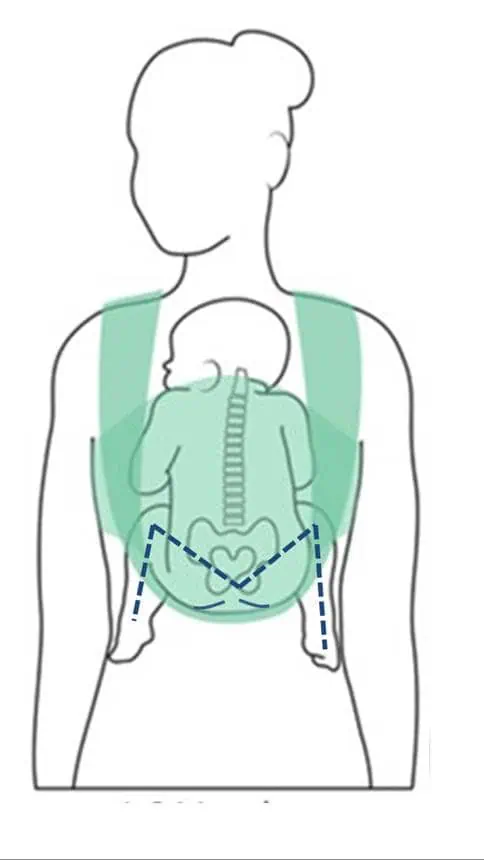
This is where babywearing comes in, because an ergonomic carrying position supports healthy hip development. The ideal position for your baby is called the M-position. The knees are higher than the bottom, the legs are spread apart, but not too wide, and the back is nicely rounded.
In this position, the hip bones fit perfectly into the hip socket. This allows the joint to develop optimally. Not only is it comfortable for your baby, it is also physiologically the best position for growing hips. Pediatric physical therapists and orthopedists therefore often recommend ergonomic carrying, especially for young babies or children with (a risk of) hip dysplasia.
If your baby has hip dysplasia, this does not mean that you have to stop carrying them. On the contrary, the closeness and support provided by carrying are extremely valuable. There are a few points to consider:
– Consult with your orthopedist or physical therapist. They can assess how carrying your baby can contribute to the treatment plan.
– Choose an ergonomic baby carrier that allows for sufficient spread and does not interfere with any spreader bandages or Pavlik harnesses.
ByKay baby carriers naturally support the ergonomic M-position and are therefore well suited to this situation.
1. Supports proper hip development: in an ergonomic baby carrier, your child sits in the M position, which keeps the hip socket in place. This not only aids recovery, but also prevents hip dysplasia from worsening.
2. Comfort with spreader pants: babies with hip dysplasia often wear a spreader bandage. In an ergonomic baby carrier, they can still be close to you safely and comfortably. The right baby carrier distributes the weight and ensures that there is no pressure on the hips.
3. Less stress and crying: Babies with hip dysplasia can sometimes feel restless due to limited movement. Carrying your baby provides comfort, rhythm, and security, which helps reduce stress and crying.
4. Helps with bonding and development: physical contact causes your body to produce oxytocin, also known as the cuddle hormone. It promotes bonding and gives a feeling of security. Babies undergoing medical treatment benefit from this even more.
5. Practical for parents: with your baby in the baby carrier, you have your hands free for everyday tasks. Meanwhile, you know that your child is sitting safely and ergonomically with you. No hassle with strollers.
Hip dysplasia in babies and babywearing are not mutually exclusive; on the contrary. With proper adjustment and an ergonomic baby carrier, you can carry your baby safely and contribute to healthy hip development.
Ensure that your child is always carried in the M-position and that you regularly consult with the treating physician regarding carrying practices.
Whether your child is wearing a Pavlik harness, spreader pants, or a regular romper, carrying them close to you is always good for bonding and development. And that is perhaps the most beautiful message for parents of a baby with hip dysplasia.
Would you like personal advice on which ByKay baby carrier is suitable for your baby with hip dysplasia? Feel free to contact us, we are happy to think along with you and your specialist.
